Montenegro Without a Car: Is Public Transport Actually Good Enough?
Every traveler planning a Montenegro trip eventually asks the same question: do I actually need to rent a car, or can I travel around Montenegro using public transport? And the honest answer is: it depends entirely on what you want to see.
Driving is undeniably the best way to explore Montenegro fully. But it is also entirely manageable to get around without a car. The important thing to know is where public transport works and, just as importantly, where it doesn’t.
💡 Quick Local Insight
Buses are the backbone of public transport in Montenegro. Trains are rarely the most practical option for tourists moving around Montenegro, although the Bar–Belgrade railway is famous for its scenery. Montenegro’s railway network is limited and serves relatively few tourist destinations compared with the bus network. Stick to buses.
How Buses Work in Montenegro
Intercity buses are the main way people move between towns, and the network covers most destinations tourists actually want to reach, at least on the coast. Services are run by a mix of small private operators, which means schedules can shift without much notice and quality varies by route and season.
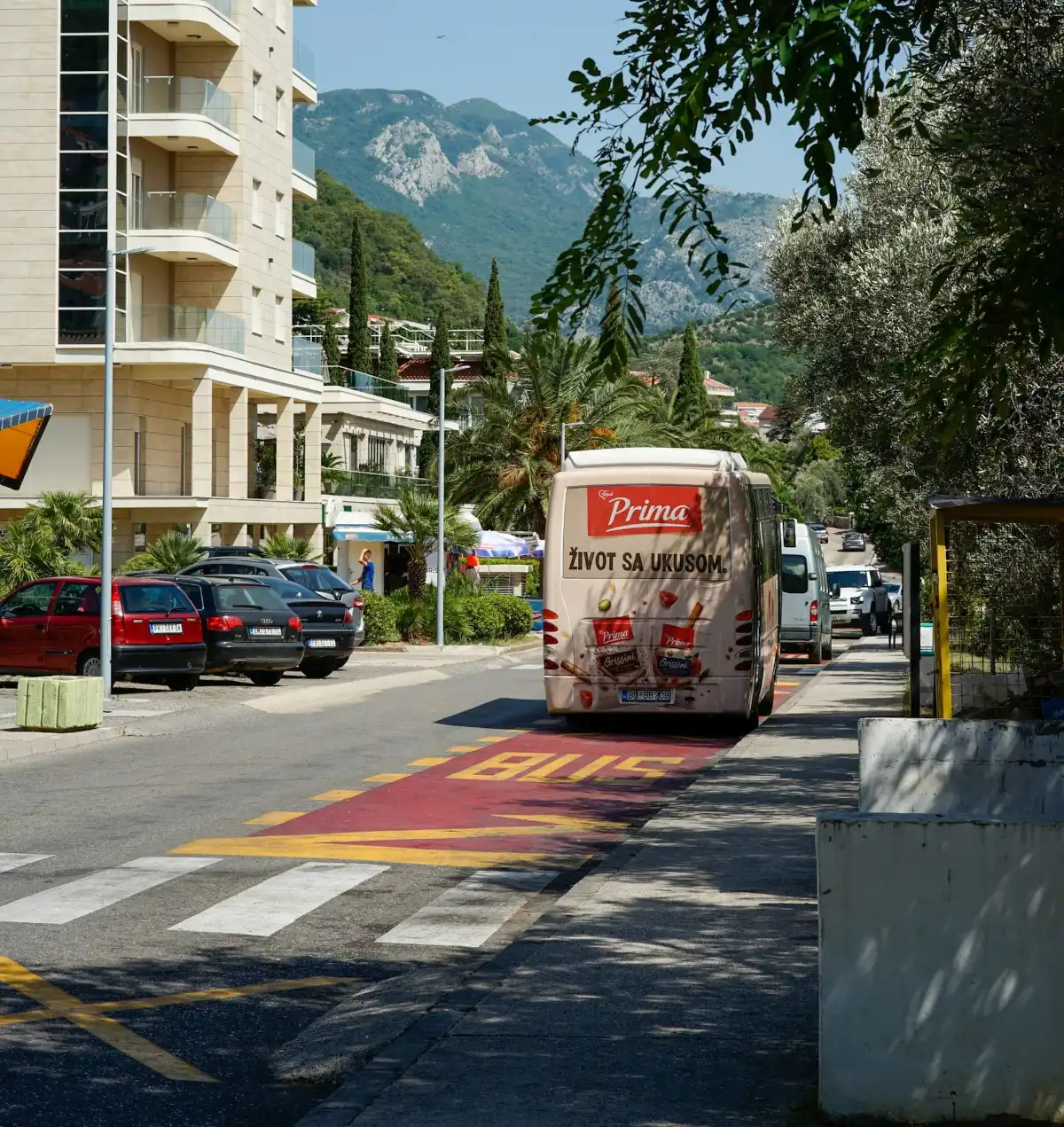
Stations in Budva, Kotor, and Podgorica are manageable but not always clearly signed in English. Give yourself a few extra minutes the first time, and don’t be surprised if staff respond in Montenegrin regardless of what language you ask in.
Bus stops: Local buses stop at smaller designated stops along the road between towns, not just at major stations.
Station and luggage fees: Expect a small station fee and a separate luggage charge (around €1 each) on top of your ticket. Bring cash, preferably small bills.
Off-season frequency: Outside summer, departures drop significantly on most routes. Always check ahead if you’re traveling in spring or autumn.
The Coastal Route: What's Actually Doable
The stretch from Herceg Novi down through Kotor, Budva, and on to Bar is genuinely well-connected. In summer, buses run every 30 minutes or so between major coastal towns. Kotor to Budva takes around 30–45 minutes and costs €3–6. It’s easy.
Base yourself in Kotor or Budva (both are compact, walkable towns) and you can day-trip up and down the coast without much hassle. Perast, Sveti Stefan, Petrovac, Bar: all reachable by bus.
During July and August, the Kotor–Budva route can take considerably longer than expected because of traffic congestion around the Bay of Kotor and the coastal highway.
💡 An Unexpected Upside
Skipping the car on the coast in summer has a real practical benefit: parking in Budva and Kotor during peak season is a genuine problem. Narrow streets, almost no space, and steep fees. Being on a bus starts to look pretty smart.
| Route | Typical Cost (pp) | Journey Time |
|---|---|---|
| Kotor → Budva | €3–6 | 30–45 mins |
| Budva → Bar | €4–7 | ~1 hour |
| Herceg Novi → Kotor | €4–7 | ~1 hour |
| Budva → Podgorica | €7–12 | ~1.5 hours |
| Podgorica → Žabljak | ~€10–15 | ~3 hours |
Where Public Transport Lets You Down
Durmitor, Prokletije, the remote mountain villages. This is where the bus network runs out of ideas. Service is thin at best and nonexistent at worst. You can get a bus from Podgorica to Žabljak (the gateway town for Durmitor), and from Žabljak you can walk to Black Lake. But beyond that you’re relying on taxis or your feet.
If your trip is built around hiking in the national parks, exploring Skadar Lake properly, or getting into the mountains at all, a car will make your life significantly easier. Public transport will get you to the door of the north, but not through it.
⚠️ Mountain Areas at a Glance
Durmitor and Prokletije are spectacular and almost inaccessible without a car. You can reach Žabljak by bus from Podgorica, but exploring beyond the town center requires either a rental or an expensive local taxi, and availability is limited.
Tips for Getting Around Without a Car
Use busticket4.me to check schedules and prices. It’s the most reliable resource for intercity routes.
Check timetables online, buy tickets at the station. You can purchase through the site, but bus drivers are known to insist on printed tickets. The site itself advises printing. Arriving at the counter 20 minutes before departure is the smoothest approach. If you board at a smaller stop rather than a main station, you pay the driver directly on the bus.
If you do buy online and need to print: your hotel will usually do it for you, or any copy shop will charge a few cents.
Taxis fill the gaps for short distances. Not cheap in tourist areas, especially Budva and Kotor in high season, but reasonable for a hop where bus timing doesn’t work. Agree on a price before getting in if there’s no meter.
In summer, coastal buses run frequently and are reasonably reliable, although delays are common during peak summer traffic. High season also brings crowds on buses and occasionally no air conditioning, which on a hot August day is as unpleasant as it sounds. Off-season is a calmer experience altogether.
Getting From the Airports to Your Accommodation
If you’re planning Montenegro travel by public transport, your airport choice matters. Tivat Airport is the most convenient option for visitors staying in Kotor, Budva, or elsewhere on the coast. There is no dedicated airport bus, but taxis are readily available and local buses pass along the main road outside the terminal, although reaching the stop requires a short walk.
Podgorica Airport is better connected to the rest of the country. A small railway station near the airport provides access to Podgorica, while buses from the city connect onward to Budva, Kotor, Bar, and Žabljak. If you’re visiting Montenegro without a car, both airports are perfectly manageable, although Tivat generally offers the easiest access to the coast.
See hotels in Podgorica, if you plan to stay in the capital.
Verdict: Should You Rent a Car After All?
For a coastal-only trip? No, you don’t need one. You can move between Herceg Novi, Kotor, Budva, and Bar without a car and have a full, satisfying trip. You’ll save money on rental and parking, and bus connections in season are frequent enough to give you real flexibility.
If you want to explore the interior (Durmitor, Prokletije, Skadar Lake properly, the mountain roads) rent a car, or at minimum rent one for a day or two while based somewhere accessible. The north of the country is spectacular and almost inaccessible without wheels.
To sum it up, Montenegro without a car is a coastal Montenegro trip. Which, for many people, is exactly what they came for.
Frequently Asked Questions
Planning Your Base on the Coast?
Kotor and Budva make excellent car-free bases. Both are walkable towns with frequent bus connections up and down the coast.